Friday, February 15, 2013

Fog (Giovanni Pascoli)

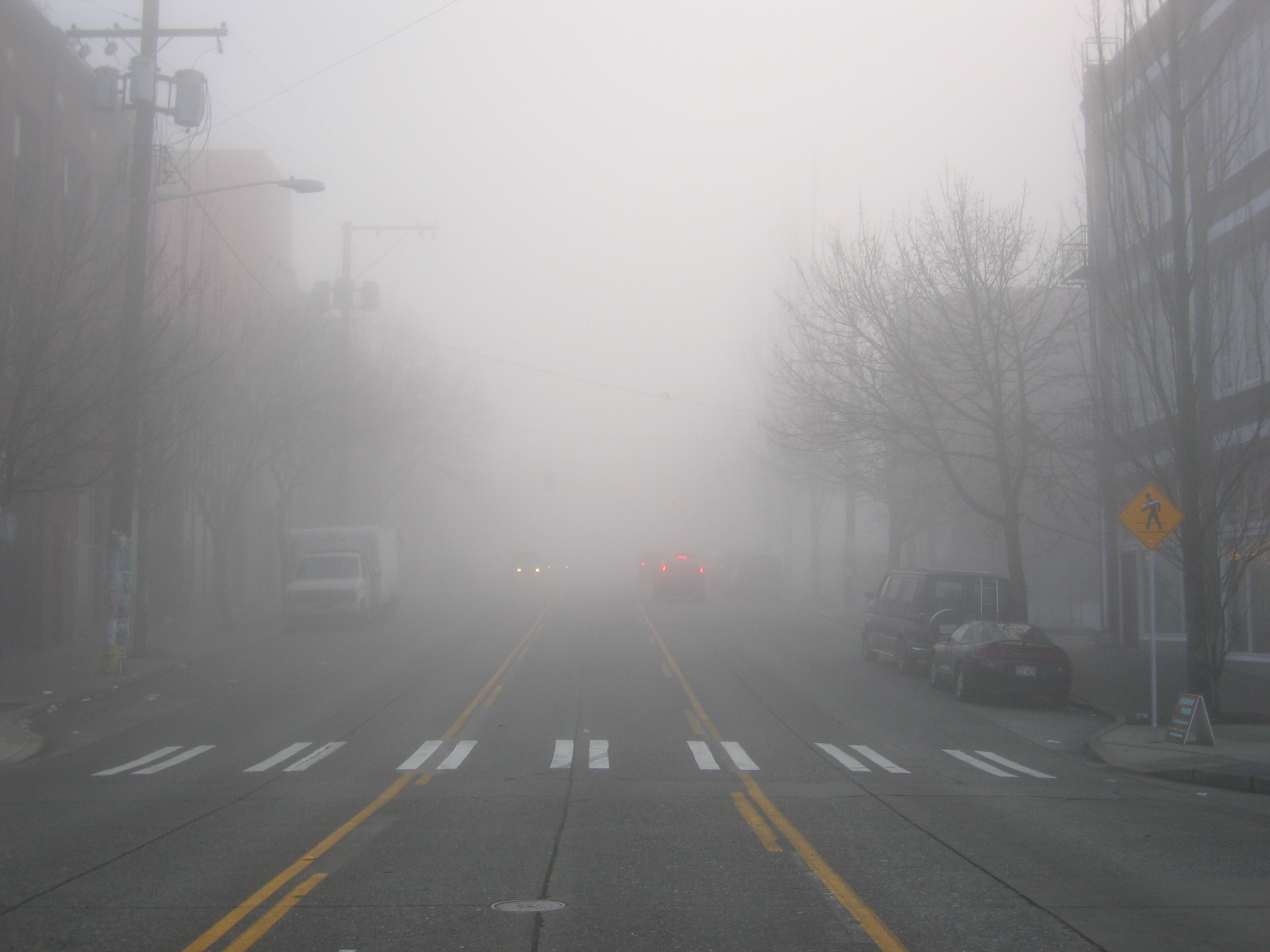
Today's poem, Fog by Giovanni Pascoli (or a better Italian version) reminds me of the fog that chokes Sacramento's streets some mornings. I had never seen much fog before I moved to California and it's such a phenomenon - it sits and obscures and eventually the sun does lift it. Somehow when they are aloft, clouds seem way more magical. Fog is not wispy or daydream-inspiring (for me, at least). It's neat, but it seems to get in the way.


Although, the N is today's poem, seems to kind of want the fog to sit and obscure many things from him. Repeatedly, he demands, "Hide every distant thing" of the fog. Maybe N's mind is too concerned with the past and future that he does not see what is present / in front of him. From the things he asks the fog to hide from him (the dead, people drunk on tears), it seems that someone he cares for has recently died and he wants the fog to insulate him from his grief. 


Which is definitely understandable, though if it's a healthy way to deal with one's grief is yet to be seen. Although, I do understand wanting space from your grief, so that N may engage with the present world - may notice - "near / to me, my dog". 

I think fog's a great metaphor for grief. It sits - seemingly immobile, obscures, is all consuming. And eventually, some midday sun lessens it until you can move about your day. 

Cool poem.

Favorite line: "Hide every distant thing, / you wan impalpable fog"

Thursday, February 14, 2013

Sometimes with One I Love (Walt Whitman)

Happy Valentine's Day!!

In the spirit of that (and acknowledging I have loads of other things to do), a short poem by a prolific writer which I will "talk" about with a single quote --> And since it is the day of love, I'll even make it easy and copy the whole (prose-y) poem here: 


Sometimes with one I love I fill myself with rage for fear I effuse unreturn'd love,
But now I think there is no unreturn'd love, the pay is certain one way or another,
(I loved a certain person ardently and my love was not return'd, yet out of that I have written these songs.)


I think this poem hits on the same truth as the following quote - which is to say, that love is grand, always worth having and never for naught.

Quote: "Love is never lost. If not reciprocated, it will flow back and soften and purify the heart." - Washington Irving

Favorite line: "Sometime with one I love I fill myself with rage"

Wednesday, February 13, 2013

Domestic (Deborah Landau)

I like this poem by Deborah Landau. The plainness of the words coupled with their subject strikes me as very suburban. So maybe this poem is limiting in that domesticity occurs in other places outside of green lawned suburbs. But then again, in comparing domestic life to a play (set roles and everyone reading from a script), she is pushing against the conformity often found in a suburban life. If everyone is acting, then at some time the domesticity must come to an end. Something must change. I wish the poem had gone on to talk a bit about that jolt. Perhaps others of hers do.

I also like that as I read this, I kept picturing a cuckoo clock's figurines turning and maneuvering in planned and pleasing ways.

Favorite line: "Life accumulates, a series of commas, / first this, then that, then him, then here. / A clump of matter (paragraph) / and here we are: minutes, years."

Tuesday, February 12, 2013

Editing Job (Carl Dennis)

In "Editing Job" (not Editing Job - a different task - sorry I couldn't use italics in the title of this post - but a cute double entendre either way) by Carl Dennis, N is running through the chapter of Job in the Bible and taking out some bits while preserving others.

I was so bored while reading this poem. The language contains no spark and the subject, while interesting, is wholly subjective (after all, maybe I think the prologue, which N recommends removing, is essential). I could hardly hear what the poet was saying since I kept wanting to give a counter argument to his objections. And N's final point - that God too makes mistakes - is hardly novel. Most modern (and not so modern) uses of God in lit. give Him human characteristics/foibles.

Favorite line: "For assuming the definition of justice/ That holds on earth holds as well above?"

Monday, February 11, 2013

Five Tiny Doves (Oni Buchanan)

I started to go to my poetry workshop again a few months ago. It's good for me, I think, to have a creative bent again. I'm also especially busy this week, so in homage to the adage [see what I did there :)] of the busiest man having the most time I've decided to restart my RTP blog. Wish me luck going forward!

Today's poem is the poem o' the day on Poetry Daily. By Oni Buchanan (bet no one else shares her name!), the poem "Five Tiny Doves" is about life/death and the sea and attentiveness and details and sensitivity and seeing and hearing, observing all.

That's what I get from the poem, at least. A fish craft and a death blow, yes, but the poem is more so concerned with all the details to be found on the boat and in the sea and in the creatures of the sea.

I should write a poem like this - pick a scene and describe. I bet Oni started with a fishing boat, but then kept finding more and more detail to write about. She starts with the boat and with a person on the boat, but then goes to the very visible school of silver fish to the not-so-easily-observed sounds of a sea slug and ends with the near-impossible-to-root-out doves in a sand dollar (if such things even exist).

I love her journey of observing. A poem, too, is like that, I think. You start with the obvious - the title or a flashy image, but you keep looking at it and it starts to divulge more of itself (or you see things not quite there - doves in a starfish, eh?).

"How much more can I ignore?" - The N in the poem questions as if chiding herself for her not noticing. Me too: How can I have ignored the ants in my front lawn this morning? How can I be so oblivious to so much action and natural beauty? How many more poems can I ignore? Thank you, today's poem, for posing the question and making me resolute to keep reading and seeing and posting.

 Favorite line: "It was clear she had carefully considered"

Sunday, April 11, 2010

Calling It

I'm just not keeping up. I think, therefore, that I will stop guilting myself on days when I don't and stop rushing myself on days when I do. I will start to post again, daily, at some undecided upon date in the future. Until then, this blog will go on hiatus. For your poetry needs, please refer to www.poets.org.

See you later!

Friday, April 9, 2010

A Supermarket in California (Allen Ginsberg)

What I love about this poem by Allen Ginsberg is that Walt Whitman features and that the way that A. Gins writes it mimics Whitman's prosey poems. I love that without even looking at the published date, I know approximately when this poem was written. It just smacks of the 1960s and hippies and the beat generation. Shoot, I just looked and it was actually written in 1956. Well, good stuff like him is always ahead of its time.

Favorite line: "Whole families shopping at/night! Aisles full of husbands! Wives in the avocados, babies in the tomatoes!"

Wednesday, April 7, 2010

In Flight (Jennifer K. Sweeney)

Not much information about the poet, but I love the poem. It's clear, clear-eyed, calm, directed. I guess that, maybe, makes it sound lame, but I mean all those adjectives in the best possible way.

I love the metaphor. I love the connection and the idea she makes between hard life - living, feeling without support or control - and the mythical Himalayan birds. God, it's just so good, so right. So damn apt.

Favorite line: "They are born in the air,/must learn to fly before falling"

Monday, April 5, 2010

MIA

I'm going to an out-of-town training for my job for the next few days. I'll be back to posting (promise!) on Thursday.

Sunday, April 4, 2010

Small Talk (Eleanor Lerman)

Never heard of the poet or the poem, but that's fine, since I like this poem and I will want to explore more of the poems of this poet. Poems of the Day are like that. They (just occasionally) direct you to a gem.

This poem moves so carefully, so cautiously. If every day in the suburbs is mild than so is the poem, making no declarations, trying to stir no ripples. Even the title pushing down what the poem's getting across by calling it simply small talk. Nothing serious is said in small talk after all. Nothing important.

But then, you see, this poem is sneaky. Not all lives are dull in the suburbs and not all small talk is pointless. This poem also contains a sharp point after carefully describing how it does not. The last stanza shows that the babes of the suburban mothers to be asleep in the arms of the wind - wild in ways that suburban life cannot approach. If they are to be wild, however, it is due to the suburban mothers - the safety of their mild ways and of their mild suburbs. "Such small talk/before life begins"

Favorite line: "If there is/sunlight, it enters through the/kitchen window and spreads/itself, thin as a napkin, beside/the coffee cup"